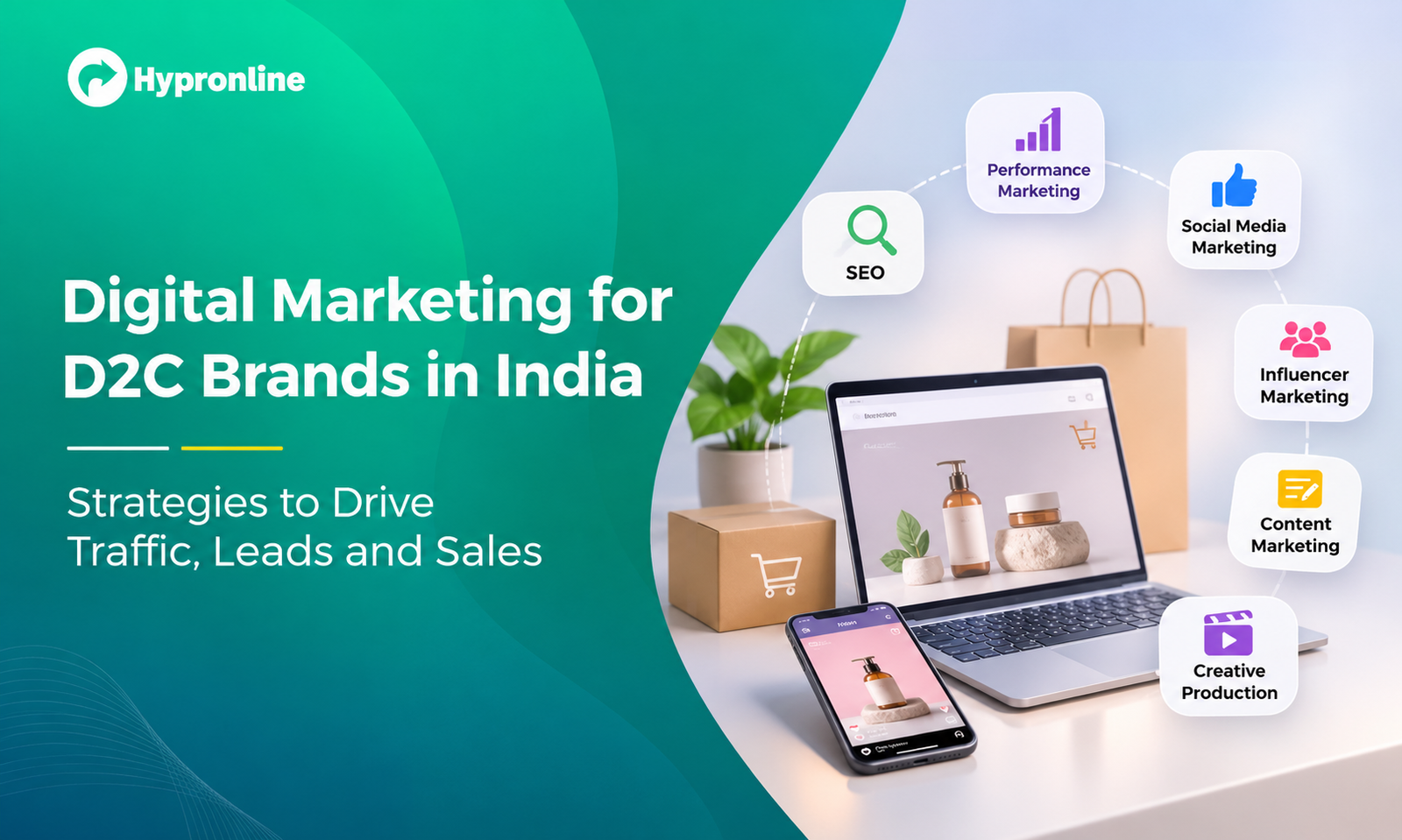
The way people discover and purchase products in India has changed significantly. Customers no longer depend only on traditional retail stores or marketplaces. They discover new brands through Google searches, Instagram Reels, YouTube videos, influencer recommendations and online advertisements.
This shift has created new opportunities for Direct-to-Consumer (D2C) brands. Businesses can now connect directly with customers, build their own brand identity and manage their online sales channels.
However, launching an online store is only the beginning. With more brands competing for attention, businesses need a well-planned digital marketing strategy for D2C brands to attract the right audience, generate consistent traffic and turn visitors into paying customers.
From SEO and performance marketing to influencer campaigns and creative content, every channel plays a different role in brand growth.
In this guide, we will explore the most effective digital marketing strategies for D2C brands in India, how to implement them and what businesses should measure to build sustainable growth.
What Is Digital Marketing for D2C Brands?
Digital marketing for D2C brands refers to using online channels such as search engines, social media, paid advertisements, email and influencer platforms to promote products and sell directly to customers.
Unlike traditional retail models, D2C brands have greater control over their customer relationships, brand communication and online shopping experience.
For example, a skincare brand selling products through its own website can use SEO to attract people searching for skincare solutions, Meta Ads to introduce products to new audiences and influencer marketing to build product awareness and trust.
A well-planned D2C marketing strategy connects these channels so that customers can discover, understand and purchase products through a consistent brand experience.
Why Do D2C Brands Need a Strong Digital Marketing Strategy?
Having a good product does not automatically guarantee online sales. Customers need to discover the brand, understand its value and feel confident before making a purchase.
A strong digital marketing strategy helps D2C businesses address these challenges.
1. Build Brand Awareness
New brands often compete with established businesses that already have customer recognition. Social media, influencer collaborations, video content and digital advertising help introduce products to relevant audiences.
2. Generate Consistent Website Traffic
Search engine optimisation, content marketing and paid campaigns can bring potential customers to a brand’s website. A combination of organic and paid traffic helps businesses reach customers at different stages of their buying journey.
3. Improve Customer Acquisition
Digital marketing allows brands to reach audiences based on their interests, search behaviour, demographics and purchase intent. This makes it easier to attract people who are more likely to be interested in their products.
4. Build Customer Trust
Product demonstrations, customer reviews, creator recommendations and useful content help customers understand what a brand offers before purchasing.
5. Encourage Repeat Purchases
Marketing should not stop after the first sale. Email campaigns, WhatsApp communication, loyalty programmes and personalised offers can encourage existing customers to purchase again.
7 Effective Digital Marketing Strategies for D2C Brands
A successful D2C business rarely depends on a single marketing channel. Different strategies work together to improve visibility, attract customers and support sales.
Here are seven important approaches that D2C brands can include in their marketing plans.
1. SEO for D2C Brands: Build Long-Term Organic Traffic
Search engine optimisation (SEO) helps D2C brands appear in search results when potential customers look for relevant products, information or solutions.
For example, someone searching for “best face serum for pigmentation” may be interested in discovering skincare products. A skincare brand with well-optimised product pages and helpful educational content has an opportunity to reach that person organically.
How D2C brands can implement SEO:
- Conduct keyword research based on products, categories and customer search intent.
- Optimise product pages with relevant titles, descriptions and headings.
- Create informative blogs around common customer questions.
- Improve website loading speed and mobile experience.
- Use internal links between blogs, product pages and category pages.
- Add descriptive image alt text and relevant product information.
- Monitor organic traffic, keyword rankings and conversions through Google Search Console and Google Analytics 4.
For long-term organic traffic growth, SEO should be treated as an ongoing activity rather than a one-time website update.
2. Performance Marketing: Drive Targeted Traffic and Sales
Performance marketing for D2C brands focuses on running paid campaigns that are measured against specific business objectives, such as purchases, leads, revenue and customer acquisition.
Platforms such as Google Ads and Meta Ads allow brands to reach potential customers through different types of campaigns.
Google Ads can help brands connect with people actively searching for products or solutions. Shopping and Performance Max campaigns can also help showcase products to relevant audiences.
Meta Ads allow businesses to introduce products to people through Facebook and Instagram. Brands can use video ads, product creatives, catalogue campaigns and retargeting to reach different audience groups.
Best practices for D2C performance marketing:
- Define campaign objectives before allocating the budget.
- Create separate campaigns for prospecting and retargeting.
- Test different ad creatives, headlines and audience segments.
- Install accurate conversion tracking.
- Monitor customer acquisition cost (CAC) and return on ad spend (ROAS).
- Optimise landing pages and product pages to improve conversions.
One common mistake is focusing only on clicks and impressions. A campaign may generate considerable traffic but still fail to produce profitable sales. D2C brands should evaluate advertising performance against revenue, margins and customer acquisition costs.
3. Social Media Marketing: Build Brand Awareness and Engagement
Social media is an important discovery channel for consumer brands. Platforms such as Instagram, Facebook, YouTube and Pinterest give businesses opportunities to introduce products and build relationships with potential customers.
For example, a fashion brand can share styling videos, a skincare brand can publish product education content, and an F&B brand can use food photography and preparation videos to attract attention.
How to use social media effectively:
- Develop a consistent content calendar.
- Publish product demonstrations and educational videos.
- Share customer testimonials and user-generated content.
- Use Reels and short-form videos to introduce products.
- Engage with comments, questions and messages.
- Maintain consistent brand messaging and visual identity.
- Track reach, engagement, profile visits and website clicks.
An effective social media marketing strategy for D2C brands should focus on building an audience that is interested in the brand, rather than simply increasing follower numbers.
4. Influencer Marketing: Build Trust Through Relevant Creators
Customers often look for recommendations and real product experiences before trying a new brand. Influencer marketing helps D2C businesses introduce their products through creators who already have an established audience.
For example, a skincare company can collaborate with beauty creators who produce product demonstrations, skincare routines and honest product experiences.
However, choosing an influencer based only on follower count can lead to poor campaign results.
How D2C brands can plan influencer campaigns:
- Identify creators whose audience matches the target customer.
- Review engagement quality and previous brand collaborations.
- Choose between nano, micro and larger influencers based on campaign objectives.
- Provide clear creative briefs without making content feel overly scripted.
- Establish content usage rights before the campaign.
- Use trackable links, discount codes and campaign reporting.
- Repurpose suitable creator content for paid advertising, with appropriate permissions.
A well-planned influencer marketing strategy can support brand discovery, product education and customer consideration.
5. Content Marketing: Educate and Engage Potential Customers
Content marketing helps brands answer customer questions and provide useful information before someone decides to purchase.
Instead of promoting products in every post, brands can create content that addresses common concerns, explains product benefits and helps customers make informed decisions.
For example:
- A skincare brand can publish guides about different skin concerns.
- A fitness brand can create educational content about workout routines.
- A food brand can share recipes and product usage ideas.
- A fashion brand can publish styling guides and seasonal recommendations.
Useful content formats include:
- Educational blog articles.
- Product comparison guides.
- How-to videos.
- Buying guides.
- Email newsletters.
- Social media carousels.
- Frequently asked questions.
Consistent content marketing for D2C brands can support SEO, improve customer understanding and give businesses more opportunities to connect with their audience.
6. Creative Production and UGC: Make Product Content More Engaging
Creative content plays an important role in how customers perceive a product. Product images, videos, demonstrations and advertisements help communicate what a brand offers.
For D2C businesses, the quality and relevance of creative assets can influence whether someone stops scrolling, visits a website or considers making a purchase.
User-generated content (UGC) is another useful format. It includes content created by customers or creators showing their experiences with a product.
Brands can use:
- Product photography and lifestyle shoots.
- Short-form videos and Instagram Reels.
- Customer testimonials.
- Unboxing videos.
- Product demonstrations.
- Creator-led advertisements.
- Behind-the-scenes content.
A consistent product video production approach can also help brands create multiple assets from a single shoot. For example, one product shoot can generate website images, social media videos, advertising creatives and short product demonstrations.
The key is to make content relevant to the audience and clearly communicate the product’s value.
7. Conversion Rate Optimisation: Turn Website Visitors into Customers
Getting visitors to a website is important, but it does not guarantee sales. If customers find the website confusing, slow or difficult to navigate, they may leave without purchasing.
Conversion rate optimisation (CRO) focuses on improving the website experience so that more visitors complete desired actions.
D2C brands can improve conversions by:
- Making product information easy to understand.
- Using high-quality product images and videos.
- Displaying clear pricing and delivery information.
- Making navigation simple.
- Offering a smooth mobile shopping experience.
- Providing secure and convenient payment options.
- Displaying genuine customer reviews.
- Simplifying the checkout process.
Brands should regularly review website analytics, identify where visitors drop off and test improvements instead of making changes based on assumptions.
SEO vs Performance Marketing for D2C Brands: What Should You Prioritise?
Both SEO and performance marketing can help D2C businesses attract customers, but they work differently.
| Comparison | SEO | Performance Marketing |
|---|---|---|
| Primary purpose | Organic search visibility | Paid customer acquisition |
| Traffic source | Search engines | Paid advertising platforms |
| Cost model | Investment in ongoing optimisation and content | Advertising spend and campaign management |
| Time to results | Generally takes time | Can generate traffic soon after launch |
| Sustainability | Can build long-term organic visibility | Traffic depends on active campaigns |
| Best suited for | Long-term visibility and organic discovery | Targeted reach, testing and campaign-driven sales |
Which should a D2C brand choose?
The right approach depends on the brand’s stage, budget and objectives.
New brands may use paid advertising to test products, audiences and creative ideas while building their organic presence. More established businesses can invest in SEO to strengthen organic visibility while continuing to use performance marketing for customer acquisition.
For most D2C businesses, combining both approaches creates a more balanced marketing strategy.
How to Build a Digital Marketing Strategy for Your D2C Brand
A digital marketing strategy should be based on business goals, customer behaviour and available resources. Here is a practical process that businesses can follow.
Step 1: Understand Your Target Audience
Identify who is most likely to purchase your products.
Consider their age group, interests, location, buying habits, problems and preferences. A skincare brand targeting young adults may require a different content and advertising approach from a premium home décor brand.
Step 2: Define Clear Marketing Goals
Decide what you want your marketing activities to achieve.
Your objectives could include:
- Increasing website traffic.
- Generating product enquiries.
- Improving online sales.
- Increasing brand awareness.
- Reducing customer acquisition costs.
- Encouraging repeat purchases.
Step 3: Choose the Right Marketing Channels
You do not need to invest equally in every platform.
Select channels based on where your target customers spend time and how they discover products. SEO, Meta Ads, Google Ads, influencer campaigns and social media can be combined depending on the brand’s requirements.
Step 4: Develop a Content and Creative Strategy
Plan content that supports different stages of the customer journey.
Use educational content to introduce problems, product demonstrations to explain solutions and customer testimonials to build confidence.
Maintain a consistent visual identity across your website, social platforms and advertisements.
Step 5: Allocate Your Marketing Budget
Divide your budget according to campaign objectives, channel performance and business priorities.
Keep some budget available for testing new audiences and creatives. Review campaign performance regularly instead of continuing to spend on activities that are not meeting their objectives.
Step 6: Track, Analyse and Optimise
Use tools such as Google Analytics 4, Google Search Console and advertising platform reports to understand how your marketing activities are performing.
Review the results regularly and make changes based on actual performance data.
Important Digital Marketing Metrics Every D2C Brand Should Track
Tracking the right metrics helps businesses understand whether their marketing investments are contributing to growth.
| Metric | What It Measures |
|---|---|
| Website Traffic | Number of visitors coming to your website |
| Conversion Rate | Percentage of visitors who complete a desired action |
| Customer Acquisition Cost (CAC) | Average cost of acquiring a new customer |
| Return on Ad Spend (ROAS) | Revenue attributed to advertising compared with advertising spend |
| Average Order Value (AOV) | Average amount customers spend per order |
| Customer Lifetime Value (CLV) | Estimated value a customer generates over their relationship with the brand |
| Repeat Purchase Rate | Percentage of customers who make more than one purchase |
These metrics should be reviewed together. For example, a high ROAS does not necessarily mean a campaign is profitable if product margins, fulfilment costs and other expenses are not considered.
D2C brands should focus on sustainable revenue and customer relationships rather than relying on a single performance metric.
Common Digital Marketing Mistakes D2C Brands Should Avoid
Even businesses investing in marketing can struggle when their strategy lacks direction.
Here are some common mistakes to watch out for:
1. Depending only on paid advertising: Relying entirely on ads can make customer acquisition expensive. Build organic visibility and customer relationships alongside paid campaigns.
2. Ignoring SEO: Without search optimisation, brands may miss opportunities to attract people actively looking for their products.
3. Publishing inconsistent content: Irregular communication can make it harder to build brand recognition and audience engagement.
4. Choosing influencers only by follower count: Audience relevance, engagement quality and content suitability matter more than follower numbers alone.
5. Ignoring website experience: Poor product information, slow pages and complicated checkout processes can affect conversions.
6. Not tracking marketing performance: Without accurate tracking, businesses may struggle to identify which campaigns and channels are generating meaningful results.
7. Focusing only on acquiring new customers: Existing customers can contribute to long-term business growth. Brands should also invest in retention, loyalty and repeat-purchase strategies.
How Can the Right Digital Marketing Agency Help D2C Brands Grow?
Managing multiple marketing channels requires planning, creative resources, technical knowledge and regular performance analysis.
A suitable digital marketing agency for D2C brands can help businesses bring these activities together through an integrated approach.
Depending on the brand’s requirements, this may include:
- SEO strategies to improve organic visibility.
- Performance marketing across Google Ads and Meta Ads.
- Social media planning and content management.
- Influencer discovery and campaign execution.
- Creative production, product photography and video shoots.
- Website optimisation and conversion tracking.
- Campaign reporting and performance analysis.
At HyprOnline, the focus is on bringing growth strategy, creative production, performance marketing and influencer marketing together. This integrated approach helps brands plan campaigns, produce relevant content and reach audiences through suitable digital channels.
For D2C businesses looking to strengthen their online presence, choosing a marketing partner that understands both brand communication and performance can make campaign planning more connected.
Explore HyprOnline’s digital marketing and growth services to understand how an integrated approach can support your brand’s marketing requirements.
Conclusion
Building a successful D2C brand requires more than having a good product and an attractive website. Businesses need a clear strategy to help customers discover their products, understand their value and feel confident about purchasing.
From SEO for D2C brands and performance marketing to influencer collaborations, social media and creative production, every channel contributes to a different part of the customer journey.
The most effective digital marketing for D2C brands combines these activities with a strong understanding of the target audience, consistent communication and regular performance analysis.
If you are looking to improve your brand’s online visibility, strengthen customer acquisition or build a more connected marketing strategy, HyprOnline can help you explore the right digital marketing and creative solutions for your business.
Ready to take your brand’s digital growth forward? Connect with HyprOnline to discuss your marketing goals.
Frequently Asked Questions
1. What Is the Best Digital Marketing Strategy for D2C Brands?
The best strategy depends on the product, target audience, budget and business goals. Most D2C brands benefit from combining SEO, performance marketing, social media, influencer collaborations and content creation. These channels work together to improve brand discovery, attract potential customers and support conversions.
2. How Can D2C Brands Increase Website Traffic?
D2C brands can increase website traffic through SEO, paid advertising, social media content, influencer collaborations and content marketing. Optimising product pages, publishing useful blogs and running targeted campaigns can help attract relevant visitors who are more likely to be interested in the products.
3. Is SEO Important for D2C Brands?
Yes. SEO helps D2C brands appear when potential customers search for relevant products, categories and solutions. Optimised product pages, category pages and informative blog content can improve organic visibility and bring relevant visitors to a website over time.
4. How Much Should a D2C Brand Spend on Digital Marketing?
There is no fixed budget for every D2C business. Spending depends on the brand’s growth stage, product margins, competition, customer acquisition goals and available resources. Businesses should start with clearly defined objectives, test suitable channels and adjust budgets based on performance.
5. Are Meta Ads Effective for D2C Brands?
Meta Ads can help D2C brands introduce products to relevant audiences across Facebook and Instagram. Campaigns can use product videos, creative advertisements, catalogue formats and retargeting. Their effectiveness depends on audience selection, creative quality, conversion tracking and the overall shopping experience.
6. How Can Influencer Marketing Help D2C Brands?
Influencer marketing allows D2C businesses to showcase products through creators whose audiences match their target customers. Product demonstrations, reviews and creator-led videos can support brand discovery and customer consideration. Brands should evaluate audience relevance and engagement rather than choosing creators only by follower count.
7. What Is the Difference Between D2C Marketing and E-commerce Marketing?
D2C marketing focuses on helping brands sell directly to customers and build relationships through their own channels. E-commerce marketing is broader and includes promoting products across online stores, marketplaces and other digital shopping platforms. Both approaches use digital channels, but their business and distribution models can differ.
8. How Can D2C Brands Reduce Customer Acquisition Costs?
Brands can work towards reducing customer acquisition costs by improving audience targeting, testing advertising creatives, optimising landing pages and increasing conversion rates. Building organic traffic, encouraging repeat purchases and using customer data effectively can also help improve overall marketing efficiency.
9. Why Do D2C Brands Need Performance Marketing?
Performance marketing helps D2C brands run measurable campaigns focused on outcomes such as purchases, leads and revenue. It allows businesses to test audiences, advertisements and channels while monitoring campaign performance. This helps marketing teams make informed decisions about budget allocation and optimisation.
10. How Can a Digital Marketing Agency Help a D2C Brand Grow?
A digital marketing agency can support D2C brands through SEO, paid advertising, social media management, influencer campaigns and creative production. By coordinating these activities, businesses can develop a more consistent marketing strategy, reach relevant audiences and track performance across different channels.