If you have been following SEO news over the last couple of years, you have almost certainly come across the term E-E-A-T. Google mentions it constantly. SEO experts debate it endlessly. And yet most Indian business website owners. even those who have been publishing content for years. have no idea what it actually means or whether their website has any of it.
In 2026, this knowledge gap is more costly than ever. With Google’s AI Overview now summarising search results before users click anywhere, and with AI tools like ChatGPT and Perplexity citing only sources they trust, what is E-E-A-T in SEO is one of the most important questions any Indian business website owner can answer. The websites Google trusts are the ones that get cited. The ones it does not trust get ignored. regardless of how good their content is.
This blog explains exactly what E-E-A-T is, what changed when Google upgraded from E-A-T to E-E-A-T, and the 10 specific steps you can take to improve it for your website in 2026. Check our [Link to: ‘On-Page SEO Checklist: 20 Things to Fix Before Publishing Any Blog’] alongside this guide for the complete on-page picture.
What is E-E-A-T in SEO?. The Direct Answer
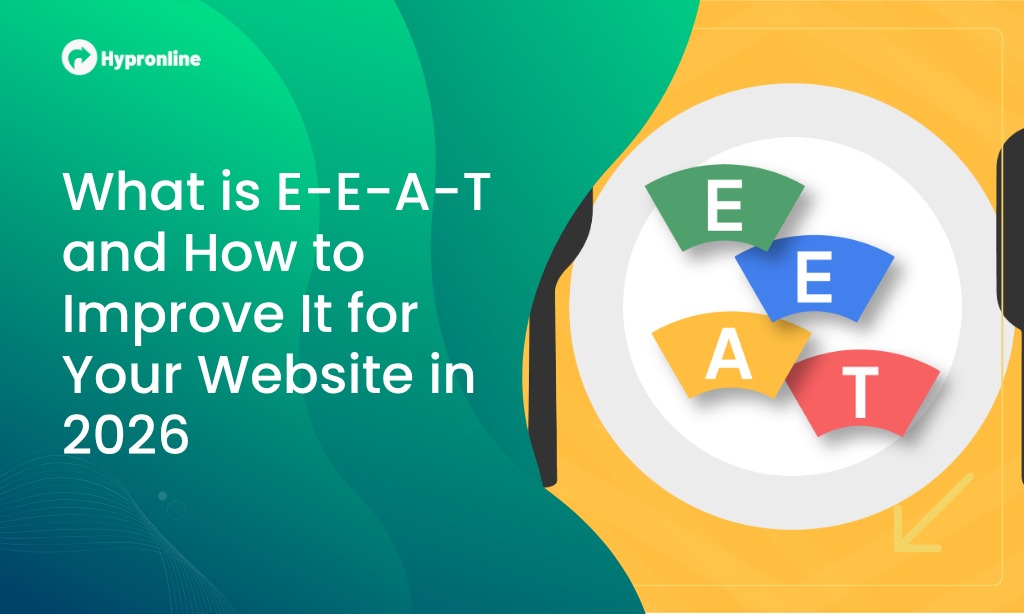
E-E-A-T stands for Experience, Expertise, Authoritativeness, and Trust. It is Google’s framework for evaluating the quality and credibility of web content, drawn from its Search Quality Rater Guidelines. a document over 170 pages long. Google uses E-E-A-T to assess whether a page deserves to rank highly, and it is especially critical for websites covering health, finance, legal, and other high-stakes topics.
What Does E-E-A-T Stand For?
E-E-A-T stands for Experience, Expertise, Authoritativeness, and Trust. four qualities Google’s Search Quality Raters use to evaluate whether a webpage deserves to rank highly in search results.
These are not abstract concepts. They are signals Google looks for in your content, your website structure, your author credentials, your backlink profile, and your online reputation. Here is a one-sentence definition of each:
- Experience: The content creator has real, first-hand, personal experience with the topic they are writing about.
- Expertise: The content creator has deep subject-matter knowledge. through education, training, or professional practice.
- Authoritativeness: The website and its authors are recognised as credible sources by other trusted websites and platforms.
- Trust: The website is honest, transparent, safe, and reliable. and users can verify who is behind it.
Trust is the most important of the four. Google’s own documentation describes it as the foundation that the other three components support.
What is the Difference Between E-A-T and E-E-A-T?
Google’s original quality framework was called E-A-T. Expertise, Authoritativeness, and Trust. In December 2022, Google upgraded it to E-E-A-T by adding a first E for Experience.
The addition of Experience was significant because it addressed a gap in the original framework. E-A-T rewarded credentials and authority. which meant a formally qualified expert could write about something they had never personally done and still rank well. E-E-A-T adds a new layer: Google now also values content written by someone who has genuinely lived or done the thing they are writing about.
Example: A travel blog post about trekking in Ladakh written by someone who has actually trekked there. with personal photos, real observations, and honest tips from the experience. now signals stronger E-E-A-T than a technically accurate article written by someone who researched it entirely from secondary sources.
Does E-E-A-T Directly Affect Google Rankings?
E-E-A-T is not a direct ranking signal. Google has confirmed there is no single ‘E-E-A-T score’ that its algorithm reads. However, it heavily influences the signals that do directly affect rankings. content quality, backlink authority, engagement metrics, and structured data.
Google trains its Search Quality Raters. real human evaluators. to assess pages using E-E-A-T criteria. Their assessments feed into how Google’s algorithms are calibrated over time. Websites with strong E-E-A-T signals are significantly more likely to survive Google core algorithm updates, while those with weak signals are consistently among the hardest hit.
E-E-A-T matters most for YMYL pages. Your Money Your Life. content that directly affects a reader’s health, financial wellbeing, safety, or legal situation. In India, this includes health blogs written by non-doctors, financial advice websites without qualified advisors, legal portals without verified lawyers, and insurance comparison sites. These categories face the highest scrutiny and need the strongest E-E-A-T signals to rank and stay ranked.
In 2026, there is another layer: 76% of Google AI Overview citations come from pages already in the top 10. pages that have earned that position largely through strong E-E-A-T signals. If you want AI engines to cite your content, E-E-A-T is the foundation. See our blog on What is GEO and AEO? How AI is Changing SEO for Indian Businesses in 2026 for how this connects to AI search visibility.
The 4 Components of E-E-A-T. Explained for Indian Websites
Experience. What It Means and How to Show It
Experience means the content creator has real, personal, first-hand involvement with the topic. Google wants to see evidence that the author has actually done, used, visited, or lived what they are writing about. not just researched it.
For Indian businesses, this means showing your actual work. A digital marketing agency in Gurgaon that writes a blog about Google Ads campaign results should reference real campaigns they have run. A nutritionist in Delhi writing about diet plans should include their own clinical observations. A travel company in Kerala writing about backwater tours should use their team’s genuine experiences. not stock photos and generic descriptions.
Quick action: Add first-person language to your blogs. ‘in our experience’, ‘we have found’, ‘when we worked with’. It signals to both readers and Google that a real person with real involvement wrote this.
Expertise. What It Means and How to Show It
Expertise means the content creator has verifiable, in-depth knowledge of the subject. through education, certification, or professional practice. Google’s Quality Raters look for evidence of this on the page and across the author’s online presence.
A CA firm in Mumbai writing about tax planning needs to signal that qualified Chartered Accountants wrote the content. not a content writer who researched it for two hours. A skincare clinic’s blog about acne treatment carries far more weight when it is attributed to a named, qualified dermatologist with a verifiable medical registration.
Quick action: Add a detailed author bio below every blog post. Include qualifications, years of experience, certifications, and a link to the author’s LinkedIn profile. This single change is one of the highest-impact E-E-A-T improvements any Indian business website can make.
Authoritativeness. What It Means and How to Show It
Authoritativeness means your website and its authors are recognised and cited as credible sources by other trusted websites, platforms, and institutions. Google measures this largely through the quality and relevance of backlinks pointing to your site.
An Indian legal portal that is cited by Bar Council publications, national news websites, or government legal resources carries far more authority than one that has never been mentioned outside its own domain. For most Indian businesses, building authoritativeness means earning coverage in industry publications, contributing expert quotes to news articles, and getting listed on credible third-party platforms like Justdial, Practo, or industry associations.
Quick action: Identify 3 authoritative Indian publications or platforms in your industry and aim to get one mention, listing, or guest contribution from each over the next 3 months.
Trust. What It Means and How to Show It
Trust is Google’s most weighted E-E-A-T component. it measures whether your website is honest, transparent, secure, and who it claims to be. Trust signals include HTTPS security, a clear About page, a verifiable business address, transparent contact information, and consistent positive reviews.
A surprising number of Indian business websites still have no About page, no team information, no physical address listed, and no SSL certificate. From Google’s perspective, these websites are anonymous. and anonymous websites do not rank well for anything that matters. Trust signals tell Google and your visitors that a real, accountable business is behind the content.
Quick action: Check that your website has: HTTPS enabled, a detailed About page with team photos and credentials, a Contact page with a physical address and phone number, and a clear privacy policy.
How to Improve E-E-A-T for Your Website in 2026. 10 Actionable Steps
1. Add Detailed Author Bios to Every Blog Post
What to do: Add a dedicated author bio section below every blog post. name, photo, qualifications, years of experience, and a LinkedIn link.
Why it improves E-E-A-T: Author bios are one of the clearest signals of Expertise and Experience. A named, credentialed author transforms anonymous content into accountable content.
Quick action: Create an author profile for every person who writes for your website. Even a 3-line bio with a real photo is significantly better than ‘Admin’ or no author attribution at all.
2. Create a Strong About Page With Real Credentials
What to do: Write a detailed About page that covers your company’s founding story, team qualifications, years of experience, industries served, and any certifications or awards.
Why it improves E-E-A-T: The About page is one of the first places Google’s Quality Raters look when evaluating a website’s trustworthiness and authority.
Quick action: Include real team photos, individual bios, and links to your team’s professional profiles. Vague ‘we are a passionate team’ copy contributes nothing to E-E-A-T.
3. Publish First-Hand Experience Content
What to do: Write content that draws on your team’s actual experience. real projects, real results, real observations. not just information that could have been found on any website.
Why it improves E-E-A-T: First-hand experience is the ‘new E’ that Google added in 2022. It is the single clearest way to differentiate your content from generic AI-generated or research-based articles.
Quick action: In every blog, add at least one section that starts with ‘In our experience at Hypronline…’ or ‘We have seen this pattern with clients in…’. genuine observations that only you could write.
4. Earn Backlinks From Authoritative Indian and Global Websites
What to do: Actively pursue mentions, citations, and links from respected Indian publications, industry bodies, news websites, and credible global sources.
Why it improves E-E-A-T: Backlinks from authoritative sources are Google’s primary measure of Authoritativeness. One link from Economic Times or Hindustan Times carries more E-E-A-T weight than 50 links from low-quality directories.
Quick action: Start a HARO (Help A Reporter Out) or Connectively subscription and respond to journalist queries in your industry. One media mention can generate significant authority.
5. Get Listed on Credible Third-Party Platforms
What to do: Ensure your business is listed and verified on relevant credible platforms. Google Business Profile, LinkedIn, Justdial, Clutch, Practo (for healthcare), or industry-specific directories.
Why it improves E-E-A-T: Third-party platform mentions corroborate your existence and credibility. Google cross-references your NAP (Name, Address, Phone) information across platforms as a Trust signal.
Quick action: Audit your current listings. Ensure your business name, address, and phone number are identical across every platform. inconsistency weakens Trust signals.
6. Add Schema Markup. Author, Organisation, and FAQ
What to do: Implement structured data markup on your website. specifically Article schema with author details, Organisation schema with business information, and FAQ schema on relevant pages.
Why it improves E-E-A-T: Schema markup communicates your content’s structure directly to Google in a language it reads precisely. Pages with author schema markup receive higher trust signals from Google’s crawlers.
Quick action: Use Rank Math (free) in WordPress to add Article, Organisation, and FAQ schema without writing code. Validate everything with Google’s Rich Results Test. Full guidance in our On-Page SEO Checklist: 20 Things to Fix Before Publishing Any Blog
7. Build and Showcase Google Reviews and Testimonials
What to do: Actively generate Google reviews from real customers and display testimonials prominently on your website. with full names and, where possible, photos or video.
Why it improves E-E-A-T: Reviews are a direct Trust signal. Businesses with 50+ Google reviews receive 4x more enquiries than those with under 10. and Google uses review volume and quality as part of its local trust assessment.
Quick action: Implement a post-purchase or post-service review request process. a simple WhatsApp message with a direct Google review link. See how our [Link to: ‘Digital Marketing for Healthcare in Gurgaon. A Complete Guide’] describes this in practice for service businesses.
8. Keep Content Updated With Fresh Data
What to do: Review and update your most important blog posts every 6–12 months. replacing outdated statistics, adding new developments, and refreshing examples.
Why it improves E-E-A-T: Outdated content signals to Google that the author is no longer engaged with the topic. Fresh, current content demonstrates ongoing Experience and Expertise.
Quick action: Add a ‘Last updated’ date to every blog post. Google’s Quality Raters look for this. it signals that someone is actively maintaining the content’s accuracy.
9. Create a Dedicated Contact Page With Full Details
What to do: Create a Contact page that includes your physical address, phone number, email, business hours, Google Maps embed, and GST or company registration number where relevant.
Why it improves E-E-A-T: A complete, verifiable Contact page is one of the clearest Trust signals on any website. It tells Google your business is real, accountable, and locatable.
Quick action: If your Contact page only has a form with no other details, rebuild it today. Every piece of verifiable business information you add strengthens your Trust score.
10. Publish Original Research, Data, or Case Studies
What to do: Create at least one piece of original research, industry survey, data analysis, or detailed case study per quarter. content that no other website has.
Why it improves E-E-A-T: Original data is the most powerful E-E-A-T signal available. It demonstrates Experience (you gathered the data), Expertise (you can analyse it), and builds Authoritativeness (others cite it).
Quick action: Survey 20–30 of your existing clients or customers on a relevant industry topic. Even a small survey produces original data that no competitor has. and that both Google and AI engines love to cite.
E-E-A-T for YMYL Websites in India
YMYL stands for Your Money Your Life. Google’s term for content that could directly impact a reader’s health, financial stability, safety, or legal rights. YMYL pages face Google’s highest E-E-A-T scrutiny.
In India, the most affected YMYL categories include health and medical blogs, financial planning and investment advice websites, legal portals and law firm blogs, insurance comparison platforms, and government scheme guidance websites. A health blog written by an anonymous author with no medical credentials, no About page, and no trust signals will struggle to rank. regardless of how accurate the information is.
If your website falls into any YMYL category, the 10 steps above are not optional best practices. they are the minimum requirement for competitive rankings. YMYL pages with weak E-E-A-T are consistently among the most penalised in Google’s core algorithm updates.
Need Help Improving Your Website’s E-E-A-T? Hypronline Can Help.
E-E-A-T is not a quick fix. it is a long-term investment in the credibility and authority of your website. But the businesses that get this right in 2026 will be the ones Google trusts, AI engines cite, and potential customers choose over every competitor.
Most Indian business websites we audit at Hypronline are missing at least 6–7 of the 10 signals covered in this blog. No author bios. A weak or missing About page. No schema markup. Zero reviews strategy. These are not difficult problems to fix. they just require the right knowledge and consistent execution.
We are a full-service digital marketing agency in Gurgaon and improving E-E-A-T for our clients websites is a core part of every SEO strategy we build. If you want to know exactly which E-E-A-T signals your website is missing and what to fix first, our free SEO audit covers all of it.
Frequently Asked Questions
Q1: What does E-E-A-T stand for in SEO?
E-E-A-T stands for Experience, Expertise, Authoritativeness, and Trust. It is Google’s framework for evaluating content quality, drawn from its Search Quality Rater Guidelines. Trust is the most important component. it underpins all the others.
Q2: Is E-E-A-T a direct Google ranking factor?
No. Google has confirmed there is no single E-E-A-T score in its algorithm. However, E-E-A-T heavily influences the signals that are direct ranking factors. content quality, backlink authority, structured data, and user engagement. Websites with strong E-E-A-T consistently outperform and outlast those without it.
Q3: What is the difference between E-A-T and E-E-A-T?
Google added a first ‘E’ for Experience to the original E-A-T framework in December 2022. The addition recognises that first-hand, personal experience with a topic is a distinct quality from formal expertise. and that both matter when evaluating content credibility.
Q4: How do I improve E-E-A-T for my Indian business website?
Start with the highest-impact steps: add detailed author bios to every blog, create a strong About page with real credentials, build Google reviews consistently, add schema markup using Rank Math, and publish content that draws on your team’s genuine first-hand experience. Most Indian business websites are missing at least half of these signals.
Q5: Does E-E-A-T matter for small business websites in India?
Yes. especially for businesses in healthcare, finance, legal services, and education. But E-E-A-T matters for all business websites because Google’s Quality Raters evaluate every category of content. Small businesses with strong E-E-A-T signals consistently outrank larger competitors with weak ones.
Q6: What is a YMYL website?
YMYL stands for Your Money Your Life. Google’s category for content that could significantly impact a reader’s health, finances, safety, or legal rights. Health blogs, financial advice sites, and legal portals are the most common YMYL categories in India. These websites need the strongest possible E-E-A-T signals to rank well.
Q7: How long does it take to improve E-E-A-T?
Some signals, such as author bios, About page, schema markup, and Contact page, can be improved within days. Others, such as backlinks, Google reviews, and topical authority, take 3–6 months of consistent effort. E-E-A-T is a long-term investment, not a one-time fix. The earlier you start, the stronger your position becomes.