The way people search for information online is changing. Earlier, most people would type a query into Google, open a few websites and compare the information themselves. Today, things are a little different. People are increasingly asking questions directly to AI-powered platforms like ChatGPT and Gemini, while Google’s AI Overviews are changing how search results are presented.
For businesses, this brings up an important question: Is traditional SEO still enough, or should brands also focus on AEO and GEO?
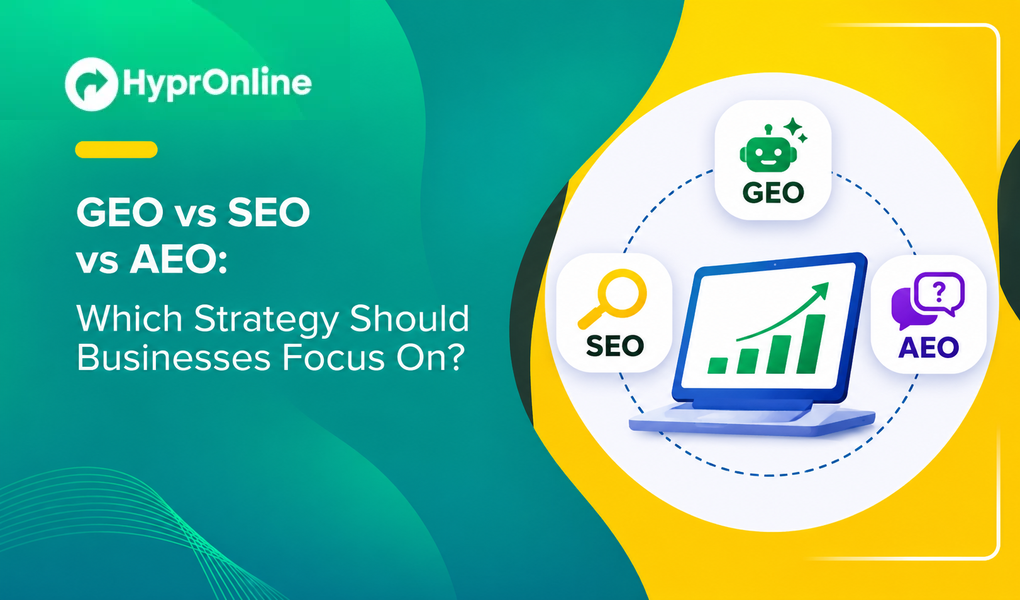
The answer is that all three approaches have a role to play. SEO helps websites appear in traditional search results, AEO helps content provide direct answers to users’ questions, and GEO focuses on improving a brand’s visibility in AI-generated responses.
Understanding the difference between these approaches can help businesses build a stronger online presence and reach customers across different search platforms.
What Is SEO (Search Engine Optimisation)?
Search Engine Optimisation (SEO) is the process of improving a website so that it can rank higher in organic search engine results. The goal is to make it easier for search engines like Google to understand website content and show relevant pages to people searching for related information.
For example, imagine someone searches for “best digital marketing agency in Gurgaon”. A business with relevant website content, useful service pages, good website performance and strong online authority has a better opportunity to appear in the search results.
SEO generally focuses on:
- Keyword research and search intent.
- High-quality website content.
- Technical website optimisation.
- Internal linking and website structure.
- Backlinks and brand authority.
- Mobile-friendliness and page experience.
- Local SEO and Google Business Profile optimisation.
SEO remains important because people still use traditional search engines to discover businesses, compare services and make purchasing decisions.
However, search results are evolving. Businesses now need to think about how their content can also answer questions directly and appear in AI-powered experiences.
What Is AEO (Answer Engine Optimisation)?
Answer Engine Optimisation (AEO) focuses on making website content easy for search engines and answer platforms to understand, extract and present as direct answers.
Think about how people search today. Instead of typing only short keywords, they often ask complete questions such as:
- What does a digital marketing agency do?
- How much does SEO cost in India?
- Which digital marketing strategy is best for a small business?
- How can I generate more leads through Google Ads?
AEO focuses on creating clear, helpful and well-structured answers to these types of questions.
For example, if someone searches “What is local SEO?”, a page that explains the concept in a short, direct paragraph followed by useful details may be suitable for a featured snippet or another answer-focused search feature.
Important AEO practices include:
- Adding relevant FAQs to website pages.
- Answering common customer questions directly.
- Using clear headings and descriptive subheadings.
- Writing concise explanations before adding detailed information.
- Organising content with bullet points and tables where useful.
- Implementing relevant structured data and schema markup.
- Understanding search intent and the questions users actually ask.
The main idea is simple: don’t just write content around keywords. Create content that genuinely answers what people want to know.
What Is GEO (Generative Engine Optimisation)?
Generative Engine Optimisation (GEO) is the practice of improving a brand’s chances of being discovered, mentioned or referenced in AI-generated responses.
Unlike traditional search engines, generative AI platforms can combine information from different sources to create a conversational answer.
For example, someone might ask ChatGPT:
“Suggest some reliable digital marketing agencies in India for a growing business.”
The platform may generate a response that mentions different agencies, explains their services or provides recommendations based on available information.
Businesses want their brands to be accurately represented and discoverable in these AI-powered experiences.
GEO focuses on strengthening the information available about a brand and making website content useful, credible and easy for AI systems to interpret.
Key GEO practices include:
- Publishing original and informative content.
- Building topical authority around relevant subjects.
- Maintaining consistent brand information across the web.
- Earning relevant backlinks and genuine brand mentions.
- Providing clear information about services, expertise and business offerings.
- Using structured content and relevant schema markup.
- Supporting important claims with trustworthy sources.
- Keeping website information accurate and updated.
It is important to understand that GEO is still an evolving area. There is no guaranteed formula that ensures an AI platform will mention or recommend a particular business.
The focus should be on building a credible online presence and publishing content that deserves to be referenced.
GEO vs SEO vs AEO: What Is the Difference?
Although these three approaches are connected, they focus on different ways of improving online visibility.
| Comparison | SEO | AEO | GEO |
|---|---|---|---|
| Main focus | Organic search visibility | Direct answers | AI-generated visibility |
| Primary goal | Improve search rankings | Help content appear as answers | Improve brand discovery in AI responses |
| Content approach | Relevant, comprehensive content | Clear question-based answers | Informative, credible and context-rich content |
| Common opportunities | Google organic results | Featured snippets and answer-focused results | ChatGPT, Gemini and other generative platforms |
| Important signals | Relevance, technical quality, links and authority | Clarity, structure and answer relevance | Content quality, brand information, authority and source credibility |
A Simple Example
Let’s take a digital marketing agency as an example.
SEO approach: The agency creates a service page targeting “digital marketing agency in Gurgaon” to improve its visibility in Google’s organic search results.
AEO approach: The agency publishes an FAQ answering “What services does a digital marketing agency provide?” in a clear and concise format.
GEO approach: The agency builds useful resources, maintains consistent brand information and develops relevant online authority to improve its chances of being referenced in AI-generated responses about digital marketing services.
All three approaches support the same broader objective: helping potential customers discover the business online.
How Is AI Changing the Way People Search?
Search behaviour is becoming more conversational. People are no longer relying only on short keyword searches. They are asking detailed questions and expecting useful answers without having to visit multiple websites.
Here are a few ways this change is affecting businesses.
1. Search Is Becoming More Conversational
People increasingly use complete questions instead of short search phrases.
For example, instead of searching “SEO services”, someone may ask, “How can SEO help my small business get more customers?”
This makes understanding search intent more important than simply targeting individual keywords.
2. AI Is Changing Search Result Experiences
Google AI Overviews and AI-powered platforms can present information in a summarised format. This changes how users interact with search results and discover information.
Businesses should continue investing in useful website content while understanding how their information may be surfaced in these new experiences.
3. Brand Credibility Matters
When users research a business, they may look beyond its website. They can explore reviews, articles, industry publications, social media profiles and other online mentions.
Maintaining accurate and consistent brand information across different platforms can support trust and discoverability.
4. Helpful Content Remains Important
Whether someone uses Google, ChatGPT or another search platform, they want reliable information.
Content that explains a topic clearly, answers relevant questions and provides practical value is more useful than pages created only to repeat keywords.
Which Strategy Should Your Business Focus On?
The right approach depends on your business goals, audience and current online presence. However, most businesses should not treat SEO, AEO and GEO as completely separate strategies.
Here is how different businesses can approach them.
1. Small and Local Businesses
Local businesses such as clinics, restaurants, agencies and service providers should build a strong SEO foundation first.
Their focus should include:
- Optimising their Google Business Profile.
- Creating location-specific service pages.
- Collecting genuine customer reviews.
- Publishing content around common customer questions.
- Maintaining consistent contact and business information online.
AEO can help these businesses answer common questions, while GEO can become part of their broader visibility strategy.
2. E-commerce and D2C Brands
E-commerce brands need to help customers discover products, compare options and make informed purchasing decisions.
They can focus on:
- Product and category page optimisation.
- Helpful buying guides and product comparisons.
- Product-related FAQs.
- Customer reviews and user-generated content.
- Clear product descriptions and structured product information.
- Strong brand presence across relevant online platforms.
3. B2B Companies and Startups
B2B companies often have longer buying journeys. Potential customers may research solutions, compare providers and evaluate expertise before contacting a business.
These companies can benefit from:
- Detailed service and solution pages.
- Industry-specific blogs.
- Case studies with verified results.
- Research-backed articles.
- Expert insights and thought leadership.
- Clear answers to common business questions.
For these businesses, building topical authority and a trustworthy online presence is particularly important.
7 Practical Ways to Improve Your SEO, AEO and GEO Performance
Instead of creating three completely separate marketing plans, businesses can follow an integrated approach.
Here are seven practical steps to get started.
1. Understand What Your Audience Is Searching For
Start by identifying the questions, problems and topics your potential customers care about.
Use keyword research, Google Search Console, customer conversations and Google’s People Also Ask section to understand search demand.
Don’t focus only on high-volume keywords. Look for questions that indicate genuine interest in your products or services.
2. Create Content That Answers Questions Clearly
Your website should provide useful information instead of simply targeting keywords.
For example, if your business offers social media marketing, create content answering questions such as:
- How does social media marketing help businesses?
- Which social media platforms are suitable for small businesses?
- How much should a business spend on social media marketing?
Provide a direct answer first, followed by a detailed explanation.
3. Strengthen Your Website’s Technical Foundation
A well-structured website makes it easier for search engines and users to navigate your content.
Focus on:
- Improving website loading speed.
- Ensuring mobile responsiveness.
- Fixing broken links.
- Creating a logical URL structure.
- Improving internal linking.
- Using descriptive page titles and meta descriptions.
- Maintaining a clear sitemap and crawlable website structure.
Technical SEO remains an important foundation for online visibility.
4. Use Structured Data Where Relevant
Schema markup helps search engines understand specific information on your website.
Depending on your business and content, relevant schema types may include:
- Organization schema.
- LocalBusiness schema.
- Product schema.
- Article schema.
- BreadcrumbList schema.
- Relevant FAQPage schema, where applicable.
Remember that adding schema does not guarantee rich results or AI citations. It should accurately represent the content visible on your website.
5. Build Topical Authority
Instead of publishing unrelated blogs, create useful content around subjects connected to your business.
For example, a digital marketing agency can cover topics such as SEO, paid advertising, social media, influencer marketing, AEO and GEO.
Connect related articles through internal links so readers can explore a topic in greater detail.
This helps establish a more comprehensive resource around your areas of expertise.
6. Strengthen Your Brand’s Online Presence
Your website is important, but it is not the only place where people discover your business.
Keep your business details consistent across relevant platforms, maintain active social media profiles, encourage genuine customer reviews and seek relevant industry mentions.
Focus on earning credibility rather than generating mentions just for the sake of visibility.
7. Track More Than Just Keyword Rankings
Traditional rankings remain useful, but they don’t tell the entire story.
Businesses should also monitor:
- Organic traffic and search impressions.
- Website enquiries and conversions.
- Google Business Profile interactions.
- Featured snippet and other search feature visibility.
- Referral traffic from relevant platforms.
- Brand mentions in AI-generated responses, where they can be checked reliably.
A combination of these metrics provides a better understanding of overall search visibility.
Common Mistakes Businesses Should Avoid
While working on search visibility, businesses sometimes make mistakes that reduce the quality of their content and marketing efforts.
Here are some common ones to avoid:
1. Treating GEO as a replacement for SEO: Traditional search still matters. Businesses should not abandon their existing SEO efforts just because AI search is growing.
2. Publishing content only for AI platforms: Content should first solve real user problems. Writing unnatural articles just to include AI-related keywords will not create long-term value.
3. Overusing keywords: Repeating the same keyword in every heading and paragraph makes content difficult to read. Use relevant terms naturally.
4. Ignoring brand credibility: An optimised website alone may not communicate the complete picture of a business. Accurate business information and genuine third-party references also matter.
5. Expecting instant results: SEO, brand authority and visibility in generative search platforms take time. There are no guaranteed shortcuts.
6. Ignoring performance tracking: Without monitoring traffic, enquiries and conversions, businesses cannot understand which activities are contributing to their goals.
Why Businesses Need an Integrated Search Visibility Strategy
The biggest mistake a business can make is treating SEO, AEO and GEO as competing marketing activities.
They are better understood as connected approaches that support different discovery experiences.
A well-optimised website can help a business appear in traditional search results. Clear answers can make its content more useful for question-based searches. Strong brand information and credible content can also support its chances of being discovered through generative AI platforms.
For example, a healthcare business may need local SEO to reach nearby patients, informative FAQs to answer common treatment questions and credible educational content to strengthen its online presence.
The exact strategy will depend on the business, its audience and the platforms its customers use.
How HyprOnline Can Help Your Business
At HyprOnline, we understand that online visibility is no longer limited to traditional search rankings. Businesses need a well-planned digital strategy that helps them connect with their audiences across different online platforms.
Our digital marketing approach focuses on building a strong online presence through services such as:
- Search Engine Optimisation (SEO).
- Answer Engine Optimisation (AEO).
- Generative Engine Optimisation (GEO).
- Content Marketing.
- Technical SEO.
- Social Media Marketing.
- Performance Marketing.
Whether you are a startup, an established business or a growing D2C brand, the right strategy should be based on your business goals, audience and market requirements.
Explore HyprOnline’s digital marketing services to understand how a structured digital strategy can support your business growth.
Conclusion
The discussion around GEO vs SEO vs AEO is not really about choosing one strategy and ignoring the others. It is about understanding how people discover information and making sure your business remains visible across different search experiences.
SEO continues to provide the foundation for organic search visibility. AEO helps businesses communicate useful answers, while GEO focuses on improving their discoverability in AI-generated responses.
For most businesses, combining these approaches into one well-planned strategy makes more sense than treating them as separate activities.
As search behaviour continues to evolve, businesses that invest in useful content, technical quality, brand credibility and a strong online presence will be better prepared to adapt.
Frequently Asked Questions (FAQs)
1. What is the difference between SEO, AEO and GEO?
SEO focuses on improving organic search visibility, AEO focuses on providing direct answers to user questions, and GEO focuses on improving a brand’s visibility in AI-generated responses.
2. Is SEO still important with the growth of AI search?
Yes. Traditional search remains an important way for people to discover websites, products and services. SEO also provides a strong foundation for content discoverability.
3. Is GEO better than SEO?
GEO and SEO serve different purposes. SEO focuses on traditional organic search, while GEO focuses on generative AI experiences. Businesses can benefit from using both.
4. How can a business optimise its website for AI search?
Businesses can publish helpful content, answer common questions, maintain accurate brand information, use relevant structured data and build topical authority. However, no particular technique guarantees inclusion in AI-generated responses.
5. Does AEO help with Google’s Featured Snippets?
Well-structured content that directly answers relevant questions may be suitable for featured snippets. However, Google independently determines which content appears in these search features.
6. Should small businesses invest in SEO, AEO and GEO together?
Yes, they can build these activities into one integrated strategy. Small businesses should begin with their core SEO and website foundations, then strengthen answer-focused content and broader AI search visibility based on their goals and resources.